

Rivers of Tomorrow at the University of the Sunshine Coast, Australia

What if the future of a river could speak?
What if the scenarios we create, the disruptions we imagine, and the futures we debate are not simply projections of human hopes and anxieties—but whispers, warnings, memories, and insistences coming from the river itself?
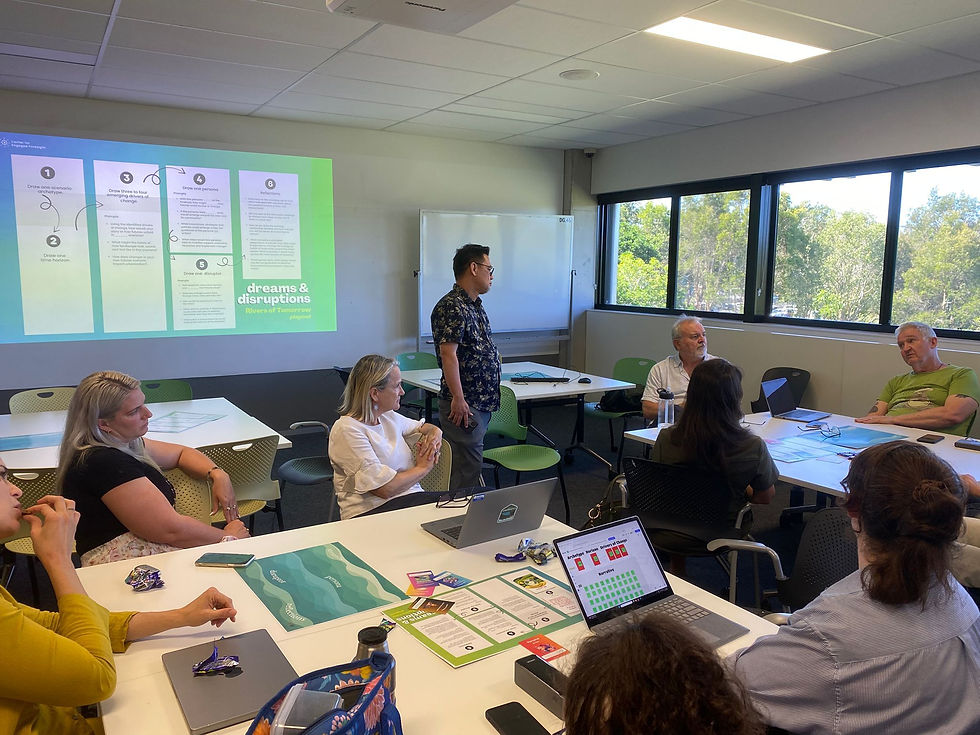
We explored this possibility during Rivers of Tomorrow: A Dreams and Disruptions Game, held as part of the launch of the Sunshine Coast Futures Hub in Australia.

The game began with deceptively simple questions:
How do we see rivers today?
Who are rivers to us?
For some, a river is infrastructure. A source of water. A drainage system. A boundary. A transport corridor. An economic resource. A recreational space.
But these descriptions reveal something important. They tell us as much about how we see the world as they do about rivers.
What changes when a river is no longer understood primarily as a resource? What if the river is a partner? A teacher? An elder? An ancestral auntie?
A friend? A living presence with memory, agency, relationships, rhythms, and perhaps even something to say about the futures we are creating?
What would your river say?
If the river beside your city could speak, what would it tell you? Would it warn you? Would it ask why you turned your back on her? Would it wonder why you built walls to contain something whose nature has always been to move? Would she tell you that she was never meant to be measured by clocks, quarterly targets, property boundaries, and election cycles? Would she remind you that rivers helped shape the civilizations we inhabit—that settlements grew around them, cultures emerged beside them, food systems depended upon them, stories travelled along them, and generations learned their seasons by watching them rise and fall?
And then would she ask:
How did something once treated as sacred become something to be channelled, engineered, polluted, commodified, and forgotten? Perhaps she would remind us that concrete does not erase memory. That pollution does not silence relationship. That floodwaters sometimes reveal landscapes we thought we had conquered. That a river remembers where it once flowed.

Listening as a foresight practice
At the Sunshine Coast Futures Hub, our game reminded me of something increasingly central to my work:
Rivers have always been speaking.
The problem may be that we rarely hear them. Or perhaps we were never taught how. Strategic foresight often begins with signals, trends, drivers, emerging issues, scenarios, risks, and possibilities. These are powerful ways of engaging the future.
But beneath these tools sits a deeper question: Whose ways of knowing are allowed to shape the future? Modern institutions tend to privilege particular forms of knowledge: quantitative evidence, expert analysis, economic calculation, technological forecasting, policy modelling.
But they are not the only ways human societies have understood change. Communities have also learned by listening to landscapes, seasons, animals, ancestors, stories, ceremonies, dreams, relationships, and patterns accumulated across generations.
What might happen if foresight learned to listen differently?
Instead of asking only:
What will climate change do to the river? we might also ask:
What would the river tell us about climate change?
Instead of asking: How can we manage the river? perhaps:
How might the river teach us to manage ourselves?
And rather than asking: How do we make rivers resilient? we might ask:
What forms of human civilization would allow rivers—and ourselves—to flourish together?
These are not simply linguistic exercises. They shift the position from which we imagine. And changing that position can change the futures that become imaginable.
From forecasting the world to relating with it
I have been reflecting on the many Dreams and Disruptions Games I have facilitated and played in different parts of the world. Across engagements with communities, students, leaders, decision-makers, researchers, and fellow foresight practitioners, I have increasingly found myself drawn toward what I think of as the epistemology of foresight:
How do we know the future?
How do our assumptions about knowledge determine which futures we notice?
What do our methods make visible?
What do they make invisible?
Who is recognised as a legitimate knower of the future?
And perhaps more fundamentally:
What kinds of relationships with the world produce different kinds of futures The future is unknowable, yet we continually attempt to relate to it. We forecast it.
We model it. We fear it. We plan for it. We colonise it with expectations.
We sometimes try to control it. But there may be other ways.
We might converse with it. Play with it. Listen for it. Allow ourselves to be unsettled by it.
And perhaps permit the future to transform the very assumptions through which we approach it.
Futures as an infinite game
This is one reason I continue to see Dreams and Disruptions as more than a game. And perhaps the future itself is an infinite game. There is no final scenario.
No final prediction. No permanent preferred future. Every future imagined creates another horizon from which new questions become possible.
The purpose, then, may not be to win by discovering the correct future.
It may be to remain capable of imagining. To expand our capacity for relationship.
To continually question what we believe is possible, desirable, inevitable, or impossible. To notice the worlds excluded by our dominant assumptions.
And to encounter futures that challenge not only what we think, but how we know. The river becomes especially powerful here because she refuses our desire for permanence.
A river moves.
It changes course.
It carries histories from one place to another.
It connects upstream decisions with downstream consequences.
It reminds us that nothing exists entirely by itself.
A river is simultaneously memory, movement, relationship, disruption, continuity, and possibility. Perhaps that is why rivers are such profound teachers of futures.
Speaking with the voice of Mother River
There is another provocation emerging from this work.
What if, occasionally, we stopped speaking about the river? What if we tried speaking with her voice? Not because we can perfectly represent what a river wants. We cannot. But because temporarily shifting perspective disrupts the assumption that humans must always occupy the centre of the futures conversation.
Imagine entering a foresight workshop and asking:
I am the river that runs through your city. What future are you creating for me?
Or:
I remember this land before your roads, buildings, and boundaries. What have you forgotten?
Or:
Your plans extend twenty years. I have been flowing here for centuries. What might your sense of time be preventing you from seeing?
Suddenly, the conversation changes. Time changes. Agency changes.
Responsibility changes. The meaning of development changes. Even the meaning of the future begins to change.
This may be especially important as we confront climate disruption, biodiversity loss, urbanisation, artificial intelligence, and other transformations that challenge the human-centred assumptions of modernity.
Perhaps imagining regenerative futures requires more than creating better technologies or policies.
Perhaps it requires developing entirely different relationships with the worlds of which we are already a part.

The provocation
This is a provocation in my continuing reflections on foresight:
What if the deepest work of foresight is not learning how to predict the
future, but learning how to listen differently?
Listen to communities. Listen to forgotten histories. Listen to future generations.
Listen to what our dominant systems refuse to hear. Listen to landscapes.
Listen to rivers.
Because the futures we create are shaped not only by what we can imagine. They are also shaped by what—and whom—we are capable of hearing.
The river may already be telling us what comes next. The real question is whether we are finally willing to listen.
Here is the link to the article I co-authored with Alija Blackwell, titled Rivers of Tomorrow: Reimagining Urban Waterways Through Foresight and Play, published in the Journal of Futures Studies.
A big thank you to the Sunshine Coast Futures Hub Team, led by Marcus Bussey, Caitlyn Noakes, Camilla Mozzini-Alister, and especially to everyone who participated in playing the game and helped launch the hub.
Reflecting from Brisbane City, Australia 10:33 PM, 19 November 2025


Comments