

Dreams & Disruptions: A Year of Innovation and Imagination in China
Games Change Futures, the World, and Ourselves
Dreams & Disruptions: A Year of Innovation and Imagination in China
By Louis Zheng
Co-Founder, Futurists Circle and Lead, Dreams and Disruptions Game, Mandarin Edition.
"Dreams and Disruptions, a foresight game, transforms many of my speculations about the future into vivid, tangible scenes and stories, offering fresh answers to current anxieties and confusions.”
A veteran player known online as ‘Anyang Says’ shared this sentiment after multiple personal experiences and hosting over 10 game workshops.
Since its introduction to China in December 2024, Dreams and Disruptions originally developed by Shermon Cruz has helped growing numbers of people rethink their relationship with self and diverse futures, even serving as a lever for individual and organizational transformation.
Over the past year, the game has been brought into businesses and nonprofits like IKEA, Volvo, IDEO, WWF, Tezign, and Dayu Community Center, as well as universities such as Tsinghua and Tongji, and events including Shanghai Climate Week, Shanghai International Design Festival, BottleDream, and the China Organizational Evolution Conference.
This article aims to discuss the origins of the Mandarin edition of Dreams and Disruptions, practical experiences, and reflections on ‘playful futures’.
Part One: From a Dinner Table Game in Dubai

Image source: FuturistCircle
In November 2023, at the Dubai Future Forum—hailed as the "world's largest futurist gathering"—we first encountered Dreams and Disruptions through an impromptu dinner game. During the organizers' welcome dinner, Shermon Cruz invited partners at the table to try the game on the spot; the moment could be summed up in one word: wow!
Prior to this, we had tested various Futures Thinking games in FuturistCircle community, often facing a dilemma: either too abstract to implement, or rules too complex with high entry barriers. In contrast, Dreams and Disruptions retains the depth of Futures Thinking while being highly accessible—players need little prior familiarity with rules, naturally co-creating future scenarios by drawing and combining cards.
In March of the following year, we decided to collaborate, systematically introducing and translating the game into Mandarin Chinese to bring more local players closer to Futures Studies. Notably, the localization project team lacks professional game design backgrounds or traditional "board game enthusiast" credentials; we are practitioners dedicated to spreading Futures Thinking and Strategic Foresight.

Image source: FuturistCircle
Why a card game?
Since FuturistCircle’s founding in 2018, a persistent challenge has been explaining Futures Thinking to the public, sparking curiosity but also misconceptions:
"Are you predicting the future?"
"Can you fortune-tell?"
"Is this metaphysics?"
Conversations often turn abstract and detached when delving into definitions and frameworks, struggling to sustain lively dialogue. We realized the need for a simpler, universal, tangible entry point—experience first, understand later—with games serving as the ideal carrier. When facilitators then explain "what Futures Thinking is" in participants' own language, understanding and resonance emerge naturally.
Part Two: Finite Games vs. Infinite Games—Learning from "Futures in the Making"
In many public events, Dreams and Disruptions marks participants' first encounter with Futures Studies/Thinking. Viewing it as an infinite game reveals its differences from most finite games (traditional board games), rooted in contrasting views of the future and action.
1. From Single Goals to Open Exploration
Finite games revolve around one goal, ending in task completion or victory. Dreams and Disruptions, as an infinite game, lets participants negotiate endpoints, keeping future outcomes open.
In practice, even groups drawing identical cards weave entirely different future narratives, highlighting futures' plurality and reminding players to set personal game goals—like resolving crises, improving quality of life, or steering the world positively. Thus, the game transcends entertainment, training players to reclaim agency in shaping futures. In an imagination-scarce era, pre-enacting futures via games is a strong start.

Image source: Medium
2. From Zero-Sum Wins/Losses to Collective Long-Term Gains
Most finite games end with clear winners and losers; Dreams and Disruptions avoids zero-sum logic. In sessions, crisis-sensing players often default to self-interest, rapidly worsening collective futures—mirroring real-world geopolitics and industry competition.
Yet in others, players—as workers, warriors, intellectuals, or merchants—break from individualism, fostering collaboration and longer-term paths, making ‘one travels fast alone, but far together’ a lived reality, not slogan.
This prompts realization: for complex challenges, quick technical solutions fall short. Technical problems can be clearly defined and solved professionally; future-shaping ones are mostly adaptive challenges requiring value and relational shifts. The VUCA world (volatility, uncertainty, complexity, ambiguity) suits adaptive challenges, demanding new perspectives, methods, and cooperation. Real issues—from career development to innovation and societal transition—resemble broad infinite games with adaptive traits: hard to name, needing stakeholder involvement and adjustments in values, beliefs, roles, relations, and workstyles. Ronald Heifetz notes organizations' common error: treating adaptive challenges technically—a pitfall for individuals too.
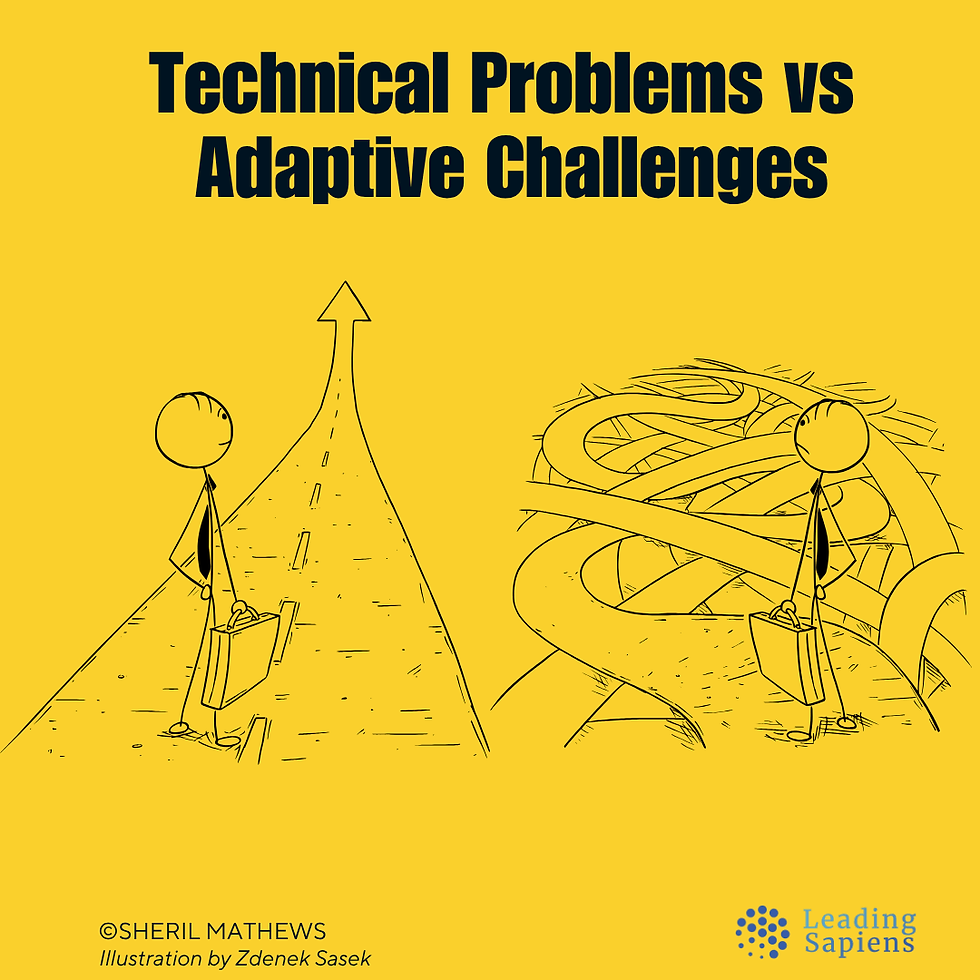
Image source: Medium
3. From Fixed Roles to Identity Leaps
Many games feature shallow roles; Live Action Role Playing (LARP) game types are overly specific, limiting imagination. Dreams and Disruptions uses four roles—worker, warrior, intellectual, merchant—representing social groups and thinking styles (from the Sarkar Game).

Image source: Medium
From a transformation view, key questions: How to notice and transcend identity frames in-game? How to enact new roles beyond old limits?
For a merchant, players might start with stereotypes—"profit-only"—then explore new merchants integrating regenerative thinking for shared futures. Multiple sessions show "awakening moments": players shift from norm-shaped typical roles to self-redefining ones, pivoting narratives.
This inward-outward transformation echoes China's classic Great Learning (investigate things 格物, gain knowledge 致知, sincerity 诚意, rectify mind 正心, cultivate self 修身, govern family 齐家, state 治国, world 平天下) and the renowned futurist Sohail Inayatullah's Causal Layered Analysis (CLA), seeking new paradigms from metaphors/myths to guide action.

Image source: Medium
Part Three: Games Meet Climate—Fostering Professionals' Futures Transformation from Inside Out
Humans drive climate change as the main source and key agents for ecological resolution.
Introducing Dreams and Disruptions, we focused: how can this game serve domain-specific practice? Climate action was an early priority, a quintessential infinite game topic.
In April 2025, the FuturistCircle partnered with Beijing's Abundant Climate Action Institute for the Climate Futures project, hosting events in Shanghai, Beijing, Shenzhen, and Bangkok embedding the game to open new thinking/dialogue for climate actors.
Image source: FuturistCircle & Abundant Climate Action Institute
A memorable collaboration: for an international environmental NGO, an one-day transformation workshop for climate narrative pros at Vanke Biosphere 3 in Shenzhen's Dameisha—a carbon-neutral demo park. The game warmed up, shifting participants from daily work to long-term future discussions.
Around game scenarios, discussions unfolded: identifying/jumping mainstream narratives; building diverse foresight/scenario planning; leveraging inner metaphors for outer action.
Practice revealed three values for climate actors:
Breaking Path Dependency: Disruptor cards shatter inertial expectations, prompting path reviews—like over-focusing on 1.5°C thresholds limiting innovation.
Reconstructing Future Narratives: Future archetype cards (preferred, worst, weird) pull from disaster-only views, encouraging ideal, extreme, insightful absurd scenarios.
Sparking Strategic Imagination/Action: Debriefs yield deep talks on paradigm shifts' emotions/insights, coalescing real-world ideas/motivation—like a green transition entrepreneur designing triple-win business paths.
Across cities/topics, we develop/introduce expansion cards for local fit. For example, in a climate narrative workshop, Dreams & Disruptions’ River Futures variant; at Bangkok Climate Action Week (BKKCAW), sci-fi writer Stanley Chen Qiufan's Sea Break for future drivers of change cards like "Gaianism," "deep-sea mining". This links sci-fi visions to co-creation.

Image source: FuturistCircle & Abundant Climate Action Institute
Part Four: Games Change Futures, the World, and Ourselves
Games turn abstract, complex, grand, distant future issues into visible, touchable, discussable, replayable experiences.
Dreams and Disruptions is a serious game: unlike entertainment board games, it emphasizes real-issue applications—as Futures Thinking training from diverse futures to present strategies, or a "future doorknocker" for new possibilities.
Through ongoing play/facilitation, participants increasingly pose post-game questions:
Which sci-fi film/literature fragments revive in-game?
Beyond familiar sci-fi, what overlooked futures exist?
Can today's subtle signals become major opportunities/challenges?
Ready if sudden scenarios hit now?
These spark self-review:
Which scenarios resonate/reject strongly?
Where do these emotions originate?
For positive hope, where does it grow?
For which futures to speak/act?
Participant Ruby noted climate crises need Futures Thinking; her experience: Futures Thinking/climate action aim to design futures actively, not await anxiously.
Abundance Climate’s Vivian shared: game space lets her set aside urges for long timescales; futures branch with choices/change, focusing on concrete lives/roles—not grand narratives alone. Futures emerge from today's decisions/imaginations interwoven.
In a podcast, social worker Weiya realized hope generates from mutual listening/expression across backgrounds—named/believed futures inspire action.
Meanwhile, China sees rising serious games on eco-sustainability, social innovation—like Shanghai Sustainable Board Game Expo's Building Better Business (B Corps), House Building (SDGs), Earthship! Spaceship (climate sci-fi), AI Thinking Cards (tech-humanity).
Image source: internet
On inner transformation: cards like regenerative Cards for Life, seasonal Naturally, relational Relation Game, era-context Era Slices.
Image source: internet
Next Steps: Inviting You to Co-Play Futures
Looking to 2026, the Dreams and Disruptions Mandarin version will root in local contexts, partnering to explore how games change futures, world, and ourselves.
Our focus areas:
Popularize Futures Thinking in Public/Education: Workshops with communities/influencers; classroom integration with academia for youth Futures Literacy.
Empower Cross-Domain Innovation: With firms/orgs, as foresight/transformation tool—e.g., Climate Futures dialogue frames.
Professional Facilitator Training (Exploring): Share futures basics/methods/tools, systematize facilitation for cross-field practitioners applying gamified cards to change.
If interested in Futures Studies/Thinking, serious games, or directions above, feel free to contact us. Eager to meet at a future game table—online/offline—practicing co-shaping futures via pre-enactment.
References and Further Reading
Dreams and Disruptions: Gaming Anti-Fragile Futures. Cruz, S. World Futures Review. https://doi.org/10.1177/19467567261422223
Technical Problems vs. Adaptive Challenges Heifetz, R. A., Grashow, A., & Linsky, M. (2009). The Practice of Adaptive Leadership. Harvard Kennedy School. [https://www.hks.harvard.edu/publications/practice-adaptive-leadership-tools-and-tactics-changing-your-organization-and-world]Revised and translated by Joey Chan, Multiple Perspectives Integral. Future Shapers Academy.
VUCA Concept Originated in U.S. military for Volatility, Uncertainty, Complexity, Ambiguity; now in management/strategy. [https://en.wikipedia.org/wiki/VUCA]
Sarkar Game Inayatullah, S. (2013). "Using Gaming to Understand the Patterns of the Future." Journal of Futures Studies. [https://jfsdigital.org/articles-and-essays/2013-2/vol-18-no-1-september-2013/article/using-gaming-to-understand-the-patterns-of-the-future-the-sarkar-game-in-action/]
Sarkar, P. R. (1998). The Law of Social Cycle.[https://prsinstitute.org/downloads/related/economics/Sarkar'sSocialCycle.pdf]
The Great Learning
Full text [https://ctext.org/liji/da-xue]
Serious Games Abt, C. C. (1970). Serious Games. [https://en.wikipedia.org/wiki/Serious_game]
Finite and Infinite Games Carse, J. P. (1986). Finite and Infinite Games. [https://en.wikipedia.org/wiki/Finite_and_Infinite_Games]
Futures Games in Classrooms Hamarat, C., & Inayatullah, S. (2017). "Serious Play." Journal of Futures Studies. [ https://jfsdigital.org/wp-content/uploads/2017/12/04SeriousPlay.pdf]
Shanghai Sustainable Board Game Expo "When 30 Complex Issues Become Board Games..." [https://mp.weixin.qq.com/s/vh4i--sfzCprFhSF6qCrEw]
Games Change Futures, World, Ourselves
Inspired by Jane McGonigal's Reality Is Broken (2011), SuperBetter (2015), Imaginable (2022).
Player Reviews/ReportsVarious WeChat articles:
Vanke Biosphere 3Project site [https://biosphere3.cn/bio3.html].


Comments