

What Fire Teaches Us About the Future

Updated: Mar 9
Some reflections on foresight, leadership, and the futures we choose to build.
Fire has a way of bringing clarity.
It does not negotiate. It does not wait for policy to catch up. It does not care whether your institution is well-funded, well-intentioned, or simply overwhelmed. Fire reveals, with brutal immediacy, what was already fragile, what was already ignored, what was already left behind.
This is partly why futures thinking and fire prevention turn out to be such a natural pairing! Both are, at their core, about what happens before the emergency.
Both ask the same uncomfortable question: are we building a world that is ready for what is coming, or are we simply hoping it doesn't?
Earlier this year, I facilitated a session with a group of fire protection practitioners using the Dreams and Disruptions Game, a participatory futures method developed by the Center for Engaged Foresight. As an Adjunct Faculty member of the Philippine Public Safety Academy, I have been bringing foresight games into professional development and learning spaces where it is rarely used and fire protection, it turns out, is one of the most fertile grounds for this kind of work.
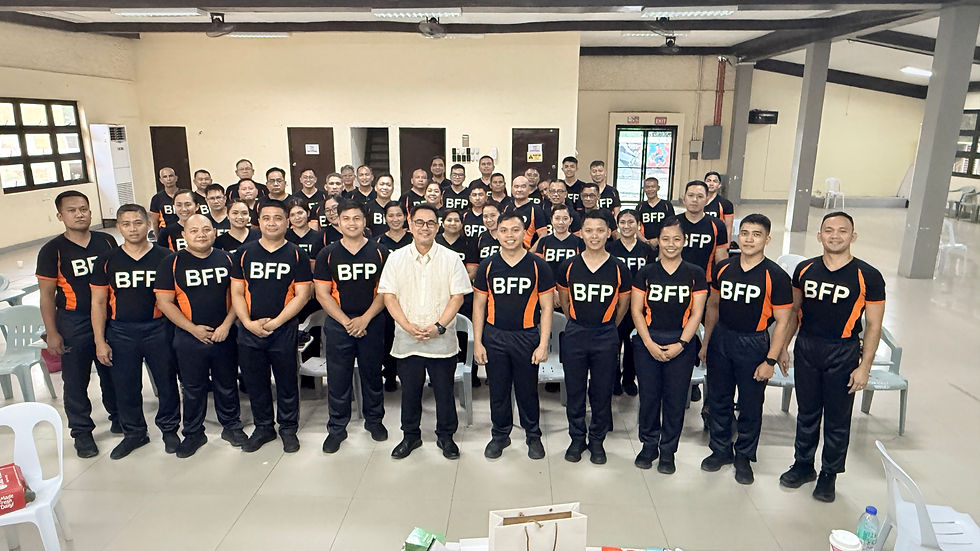
Through the Dreams and Disruptions Game, participants randomly drew cards that provided them with a thirty-year time horizon and a series of provocative forces of change, leadership archetype and planetary disruption.
Next, they were prompted to envision: what will fire prevention look like in 2056? What influences are shaping it? Who will be at the forefront? And what occurs when a truly catastrophic event disrupts it?
What emerged from the room wasn't a technical perspective on fire safety and prevention. It was their perspectives on how those working on the frontlines of public safety perceive governance, leadership, authority, and the future of the communities they serve.
Here are some lessons that are worth sharing.
Lesson 1: Fire prevention involves more than just addressing fire
The first thing that strikes you when you read through the participants' futures is how quickly fire prevention expands beyond fire.
In a set of scenarios, by 2056, fire prevention is closely linked with climate adaptation, water security, and ecosystem management. The ocean's temperature has increased. Droughts have become more severe. Methane is escaping from deteriorating seabeds. The risk of ignition has changed, not solely due to human negligence, but because of a chain reaction of ecological breakdowns. In this future, Fire Marshalls have evolved from being mere inspectors to environmental risk analysts, interpreting atmospheric data, monitoring methane emissions, and collaborating with climate agencies to avert fires before they ignite.
In a different scenario, the disturbance is geopolitical instead of ecological. A nuclear winter has arrived. The sky is dimmer. The air is chillier. Paradoxically, the risk of fire has risen not due to widespread fires, but because people in need are warming makeshift shelters with makeshift fuel. The heater turns into a danger. The generator becomes a menace. The stove in an enclosed space becomes lethal.
Both of these scenarios convey the same fundamental lesson: the limits of fire prevention are determined by the environment it functions within, not necessarily by the organization that oversees it.
When the world changes — ecologically, geopolitically, technologically — the meaning of fire prevention evolves with it.
This is not a theoretical observation. It is already occurring. Heat-induced wildfires are increasing in both frequency and size. Urban densification is amplifying risk in ways that outdated fire codes did not foresee. Climate stress is altering the geography of danger.
The professionals envisioning these futures were not indulging in fantasy. They were projecting based on the pressures they currently experience.
The consequence for any organization involved in public safety is straightforward:
you cannot plan for fire in isolation from a world that enables it.
Thus, preparing for fire requires considering the environment that leads to it.
Lesson 2: The same drivers produce very different futures depending on who is leading
This is the point where the exercise takes on a philosophical and political interest.
All the scenarios in this workshop were built from the same two drivers of change. The first was an extreme deterrence logic — the idea that some violations are so grave, so willful, so deadly, that the harshest possible sanctions must remain on the table. The second was a cooperative economics framework — the idea that fire safety is a public good, that the cost of compliance cannot be left entirely to private capacity, and that the state has a responsibility to distribute protection equitably.
Same drivers. But two radically different futures emerged — because the leadership archetype changed.
In the first future, leadership is grounded in ethics, spirituality, and moral authority - the Sadvipra. The institution is incorruptible. It is trusted. It frames fire prevention not as regulatory enforcement but as stewardship. Fire prevention is a civic and even sacred duty.
Compliance is produced through a combination of fear, respect, and shared purpose. The deterrence is severe, but it is justified through a moral language of collective survival. Communities are trained. Equipment is distributed. Fire safety becomes part of everyday citizenship.
In the second future, leadership is investment-driven and innovation-oriented. The Capitalist. Fire protection institutions partners with technology firms, infrastructure providers, and data platforms. Compliance is measured continuously, ranked, and recorded. Incentives replace exhortations. Tax exemptions replace moral appeals. Fire prevention becomes profitable which means it scales fast, modernises quickly, and integrates seamlessly with economic development goals.
Both futures are stringent. Both maintain severe sanctions. Both are technologically sophisticated. But their internal logic or the reason the system works, the source of its authority, the basis on which people comply are completely different.
In one future, people comply because they trust the institution. In the other, they comply because the system makes it rational to do so.
This distinction is crucial not only for fire prevention but also for any governance institution striving to establish legitimacy in stressful conditions.
The moral leadership model (Sadvipra archetype) is powerful precisely because it can function even when incentives break down. Trust, duty, and shared purpose are resilient social technologies. They do not require functioning markets or stable infrastructure. But they carry their own risk: an institution whose authority is moral can also make its coercion appear righteous. The same ethical framework that builds trust can justify extraordinary punishment.
Under crisis conditions, the line between principled discipline and sanctified authoritarianism can become dangerously thin.
The investment leadership model (Capitalist archetype) is powerful because it is scalable, measurable, and self-reinforcing. Systems that make safety profitable tend to modernise faster and deliver more consistent results. But they carry their own vulnerability: capital flows to where returns are highest. When resilience is built through investment, protection tends to concentrate in economically strategic spaces first.
Communities at the margins — the ones already most vulnerable to fire — may wait the longest for advanced systems to reach them.
Each is a different answer to the same question: in a damaged world, what kind of order makes people safe?
That question, it turns out, is not a technical one. It is political and philosophical.
And the fact that a group of fire protection practitioners surfaced it so clearly — without being prompted to think in those terms — says something important about the depth of reflection that futures thinking can unlock.
Lesson 3: Disruption doesn't halt the work — it reshapes and expands it
Perhaps the most instructive part of the exercise was what happened when a major disruption was introduced into each scenario.
Under a nuclear winter, fire prevention does not pause. It expands and transforms. The risks change — from conventional structural fires toward heating hazards, improvised fuel use, and shelter combustion. The methods change — from physical inspection toward remote drone assessment, robotic tools, and protective equipment. The priorities change — from code checking toward integrated survival management. But the work continues. The institution adapts.
Under ocean system collapse, fire prevention does not retreat. It expands. The new risk landscape — drought-fire interactions, methane accumulation, heat intensification, water scarcity — demands new competencies, new partnerships, and new infrastructures. But again: the work continues. The institution evolves.
What struck all of us was that no body imagined a future in which fire prevention simply gave up under disruption. Every scenario, in some form, imagined an institution that adapted, absorbed the shock, and kept functioning however differently.
And because it suggests that the participants were not simply imagining better fire prevention. They were imagining a more resilient kind of institution — one whose identity is not tied to any single method, technology, or operating context, but to a deeper purpose: protecting life from fire, whatever form that protection needs to take.
The lesson for leadership is this: organisations that survive disruption are not the ones that planned perfectly for it. They are the ones that knew, with clarity, what they were fundamentally for and were able to reorganise around that purpose when everything else changed.
Lesson 4: Technology is not neutral — it takes the shape of whoever governs it
Both futures imagined in this workshop are technologically advanced. Drones. Artificial intelligence. Satellite-linked risk mapping. Autonomous suppression systems. Remote sensing. Smart buildings that report their own compliance data. Self-updating risk scores.
But the same technologies play very different roles in the two scenarios.
In the ethics-led future, technology is subordinate to moral purpose. Drones are used to protect inspectors in hazardous zones, not to replace human judgment. Automated alerts support community preparedness, not surveillance. Data flows toward accountability and transparency. The technology serves the ethical framework.
In the investment-led future, technology is the primary mechanism of governance. Buildings are continuously monitored. Compliance is measured and ranked. Citizens interact with fire prevention through dashboards and digital platforms rather than through community drills and civic education. The technology is the system.
Neither of these is wrong. They can be an instrument of equity or an instrument of stratification, depending on who deploys it and toward what end.
AI-driven fire risk mapping can identify vulnerable communities early and direct resources toward them or it can optimise for asset protection and leave poor neighbourhoods under-served. Drone inspection can extend the reach of under-resourced fire services into remote areas or it can replace the human relationships that make community fire safety work. Compliance scoring can create transparent, fair enforcement or it can penalise communities that lack the economic capacity to achieve high scores.
The technology itself does not decide. The governance model does.
This is perhaps the most interesting insight from the entire exercise. Any organisation integrating advanced technology into public safety work needs to ask, explicitly and repeatedly: what values is this technology serving, and whose interests does it protect first?
Lesson 5: Fire prevention efforts mirror the type of governance in place
This is possibly the most important.
By the end of the exercise, it became clear that the participants were not really just imagining fire prevention. They were imagining governance. They were expressing views about what kind of authority they trust, what kinds of punishment they find acceptable, how they think public goods should be distributed, and what they believe the relationship between the state and the citizen should look like under conditions of extreme stress.
Fire, it turns out, is a lens. Because it is immediate, consequential, and universal. Everybody is at risk, and everybody has a stake in preventing it. Fire strips away abstraction and forces people to articulate what they actually believe about order, fairness, and collective responsibility.
One of the most revealing patterns in the workshop data was the consistent tension between two impulses that participants held simultaneously: a desire for stronger enforcement, and a desire for more equitable support.
Nearly every participant imagined both a world in which non-compliance carried severe consequences and a world in which the government helped people comply in the first place. The harshness and the care were not contradictions in their minds. They were two sides of the same commitment to a society where fire does not kill people who could have been protected.
That is not a fire prevention insight alone. It is a governance insight. It is an insight about what people want from institutions when they are thinking seriously about the future.
Final Reflection: The Distinctive Benefits of Gamified Futures Thinking Compared to Conventional Training
A gamified futures thinking exercises do something that conventional professional training rarely achieves: they create the conditions for people to think beyond their current role, beyond their current context, and beyond their current assumptions.
The practitioners in this workshop did not produce a strategy document. They produced something harder to categorise and more valuable: a set of aspirations, alternative visions, tensions, and questions that no single person could have generated alone, and that no formal curriculum would have surfaced.
They imagined fire prevention as a moral system and as an economic system.
They imagined leadership as ethical stewardship and as investment-driven innovation. They imagined disruption not as the end of the work, but as its transformation. And in doing all of this, they revealed something about how people who are deeply embedded in a public safety institution actually think about the future of the society they are protecting.
That is what good foresight work looks like. Not prediction. Not mere planning.
However, the structured, creative, and cooperative effort of considering the future earnestly before it unfolds, while there is still an opportunity to influence it.
Fire does not wait. The future does not wait. Neither should we.
This post was written by Shermon Cruz, inventor of the Dreams and Disruptions Game and Adjunct Faculty of the Philippine Public Safety Academy and a Fellow of the Philippine Public Safety College. This draws on insights from a Dreams and Disruptions Game session he facilitated with fire protection practitioners.
The Dreams and Disruptions Game is a participatory futures method developed by the Center for Engaged Foresight. The ideas, tensions, and scenarios described here are collective outputs of the participants, was synthesized with the assistance of artificial intelligence for general audience interested in foresight, leadership, and public safety.


rr88 mình cũng kiểu nghe người ta nhắc hoài nên bấm vào nghía thử cho biết thôi, chứ không rảnh ngồi đọc kỹ từng thứ. Vừa vào thấy trang làm khá “dễ thở”, khoảng trắng vừa đủ nên nhìn không bị dồn chữ hay rối mắt. Mình thích nhất là cách họ chia nội dung thành mấy khối riêng, kéo xuống tới đâu biết mình đang xem phần nào tới đó. Thanh menu đặt ngay chỗ dễ thấy nên đổi qua lại cũng nhanh, không phải mò. Nói chung cảm giác dùng như lướt một trang tin gọn gàng, không bị ngợp bởi quá nhiều thứ cùng lúc. Nhìn tổng thể ổn vì các khối nội dung tách rõ và…